1851
The downtown acreage
Benjamin Campbell bought 160 acres and planted hay and grain. The City identifies that acreage as the later historical downtown core.
City history · checked July 26, 2026

Campbell's civic shape begins with land and fruit, runs through a rail corridor, and keeps changing through public reuse, regional transit, law, and layers of ownership.
Each stop is a source handoff, not a claim that one page owns the whole story.
Benjamin Campbell bought 160 acres and planted hay and grain. The City identifies that acreage as the later historical downtown core.
City history · checked July 26, 2026
Campbell sold land to the railroad in 1878. By 1887, the first subdivision had been recorded west of the tracks between Campbell Avenue and today's Water Tower Plaza.
City history · checked July 26, 2026
Fruit shipping, drying grounds, and canneries made Campbell a rail center. The Campbell Fruit Growers' Union operated a 17-acre drying yard.
City history · checked July 26, 2026

The Tudor-style home built for cannery pioneer J.C. Ainsley now stands beside the civic center as a house museum.
Campbell Museums · checked July 26, 2026
The downtown tower became Campbell's most recognizable vertical landmark even after the tank stopped serving its original purpose.
City public art and history · checked July 26, 2026

Campbell officially incorporated as a city in 1952 after its offices had occupied Fire House No. 1 and the old Congregational Church.
City history · checked July 26, 2026

PruneYard Shopping Center v. Robins began with students petitioning at the Campbell center. The Court upheld California's protection of speech and petitioning there.
Cornell Legal Information Institute · checked July 26, 2026

The former high-school auditorium reopened as Heritage Theatre, and VTA's Vasona extension brought light rail to Downtown Campbell and Winchester.
Heritage Theatre and VTA · checked July 26, 2026

Campbell is its own city, but ordinary tasks continue across County, VTA, library, school, utility, business, and private systems. The boundary is part of the civic story.
Campbell ownership map · checked July 26, 2026

The 2003 artwork at the Community Center uses a pattern evocative of fruit drying in trays and commemorates a place that once held one of the world's largest drying grounds. The new site's orchard-tray grid follows that published Campbell material rather than inventing a heritage costume.
A civic grid drawn from Campbell’s fruit-drying trays.
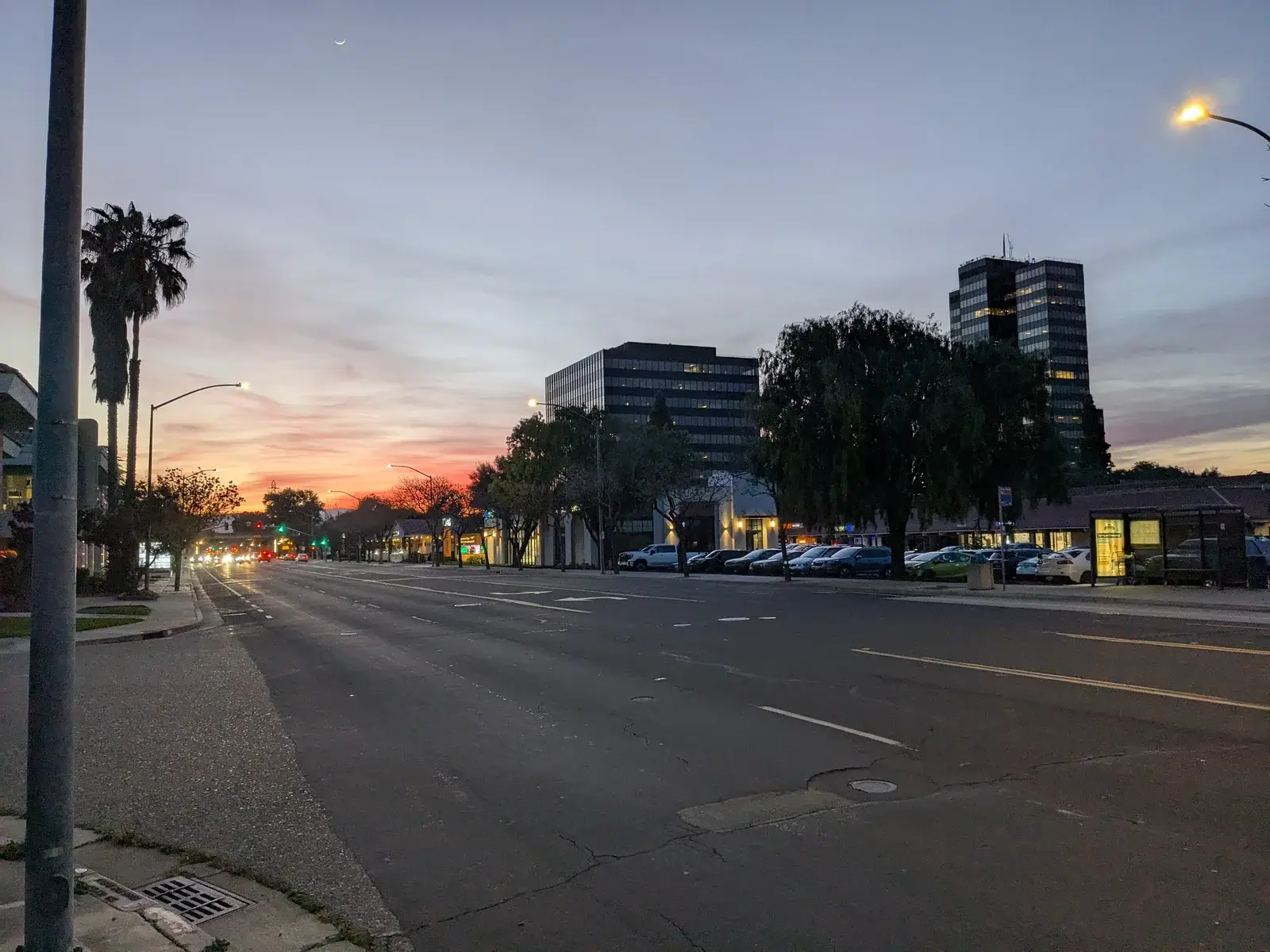
Campbell's most legible public life still converges around the old rail line, water tower, civic center, market, museums, theatre, and transit. The site uses that compression as its organizing clue.
See Campbell on the ground